Effect of sol-gel preparation on the microstructural and thermal behavior of nanosized powder of mesoporous hydroxyapatite
DOI:
https://doi.org/10.4279/pip.180001Keywords:
sol-gel, microstructural, thermal, hydroxyapatite, adsorbentAbstract
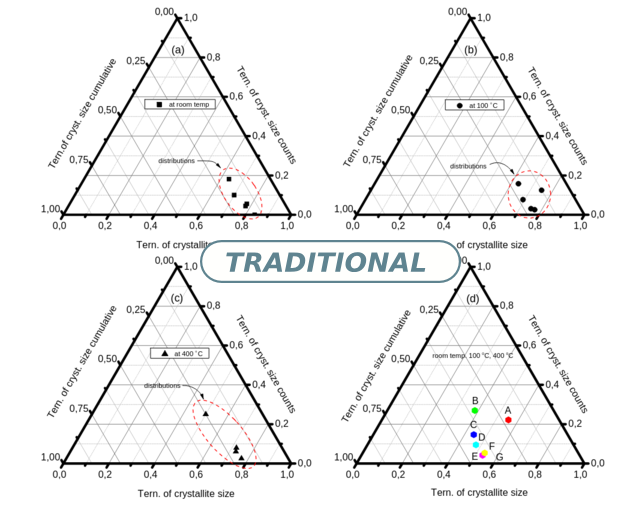
The effect of sol-gel preparation on the microstructural and thermal behavior of nanosized mesoporous hydroxyapatite powder was investigated in this study. The powder was synthesized using the sol-gel technique, with preparation carried out at various temperatures: room temperature 100°C and 400°C. FTIR analysis revealed the presence of hydroxyl groups (3423.91 cm−1 to 3600 cm−1), corresponding to the stretching vibration of hydroxyl (OH) and phosphate ions (1102.31 cm−1 to 1644.17 cm−1), indicating the stretching vibration of P - O, and these indicating the functional groups of PO43- , confirmed as the formation of hydroxyapatite. The thermal properties were studied using DSC-TG and provide valuable information on phase transitions such as melting, crystallization, thermal enthalpy, and specific heat capacity. XRD analysis confirmed all materials as nanosized mesoporous hydroxyapatite powder with face-centered cubic unit cells in the hexagonal lattice system. The lattice constants were obtained, a = b = 0.942 nm and c = 0.588 nm; these results were determined by careful analysis using the appropriate interplanar spacing formula. Finally, the surface topology and elemental composition were examined using SEM-EDX, including the atomic ratio of elements in the nanosized mesoporous hydroxyapatite powder. The Ca/P ratios were found to be approximately 1.63 and 1.73 for samples treated at temperatures of 100°C and 400°C, respectively. In the future, nanosized mesoporous hydroxyapatite powder, synthesized by the sol-gel method, could be prepared as a raw material for waste adsorbents.
Downloads
Published
How to Cite
Issue
Section
License
Copyright (c) 2026 Jan Ady, Djony Izak Rudyardjo, Gunarti Meylinda Putri, Akhmad Arsyad Ulul Amri

This work is licensed under a Creative Commons Attribution 4.0 International License.
Authors agree to the PIP Copyleft Notice