Power flux in a three-layer slab waveguide with graphene interfaces and a metamaterial core
DOI:
https://doi.org/10.4279/pip.180004Abstract
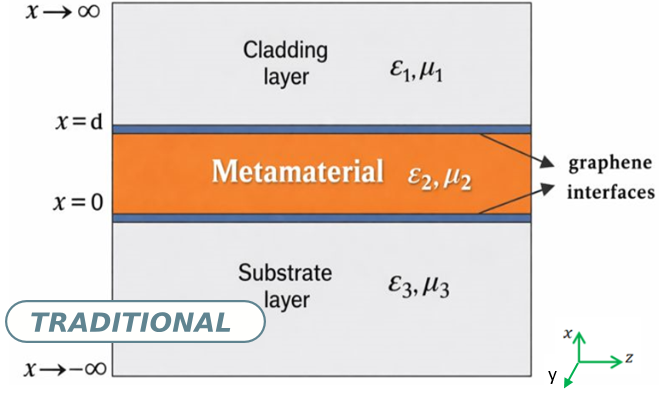
This paper presents a theoretical study of the electromagnetic wave propagation in a three-layer slab waveguide with a metamaterial core and graphene interfaces on each end. The dispersion relation, field distribution, and power-flux expressions are then analytically formulated to obtain the impact of the magnetic permeability of the central layer and graphene Fermi energy on the guided modes. It is found that by changing core permeability, the basic TE$_0$ mode can be suppressed or allowed, and other higher-order modes can propagate consistently. The analysis of power flux shows how there is forward and backward energy flow, where negative values of the flux show that there is backwards-wave flow in the structure. Moreover, mode confinement and alteration in power distribution within the layers occur with an increase in Fermi energy. It is seen that graphene-metamaterial waveguides have a bright future in terms of reconfigurable photonic platforms, with potential uses in optical communication, slow-light devices, and plasmonic control technologies.
Downloads
Published
How to Cite
Issue
Section
License
Copyright (c) 2026 Nawal N. Amsir, Hassan A. Yasser

This work is licensed under a Creative Commons Attribution 4.0 International License.
Authors agree to the PIP Copyleft Notice