Green synthesis, characterization, and antibacterial efficiency of copper oxide nanoparticles using Mitragyna speciosa (Korth.) Havil leaf extract
DOI:
https://doi.org/10.4279/pip.180002Keywords:
Green synthesis, CuO NPs, Mitragyna speciosa (Korth.) Havil, Antibacterial activity,, Debye-Scherer’s formula, Williamson–Hall (W-H) analysis, Crystallite sizeAbstract
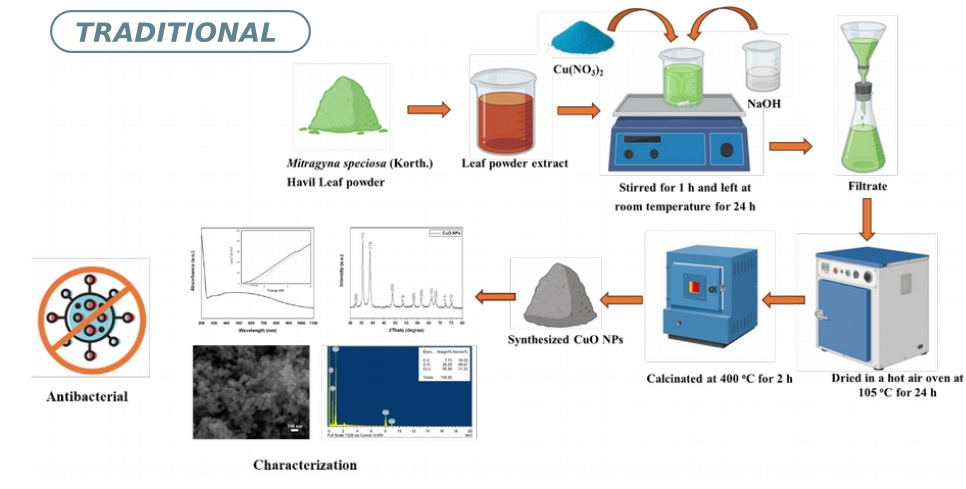
Copper oxide nanoparticles (CuO NPs) possess versatile properties that make them valuable in various applications, including electronics, catalysis, sensing, and biomedical fields. However, conventional synthesis routes often require high energy input, hazardous chemicals, and generate environmentally problematic byproducts. In this work, CuO NPs were synthesized through an eco-friendly green method using Mitragyna speciosa (Korth.) Havil leaf extract, whose phytochemicals function as natural reducing and stabilizing agents. The nanoparticles were characterized using UV–visible spectroscopy, FESEM–EDS, and XRD. The optical spectrum exhibited an absorption maximum at $\sim$480 nm, and the corrected Tauc analysis yielded an indirect band gap of 1.57 eV. XRD analysis confirmed the formation of monoclinic CuO with crystallite sizes of 82--98 nm (Scherrer and Williamson–Hall methods), consistent with FESEM particle sizes of 50--80 nm. Antibacterial tests revealed activity against both Escherichia coli and Staphylococcus aureus, with minimum inhibitory concentrations (MICs) of 3.98 $\times$ 10$^{4}$ $\mu$g/mL and 1.00 $\times$ 10$^{5}$ $\mu$g/mL, respectively. These results demonstrate that M. speciosa-mediated synthesis offers a viable, cost-effective, and sustainable approach for producing functional CuO nanoparticles, thereby supporting their potential in future environmental and biomedical applications.
Downloads
Published
How to Cite
Issue
Section
License
Copyright (c) 2026 Voranuch Thongpool, Sarawut Jaiyen, Akapong Phunpueok, Nuchita Sukprasit, Atipong Bootchanont

This work is licensed under a Creative Commons Attribution 4.0 International License.
Authors agree to the PIP Copyleft Notice